Dubai Car Lift Review: Sharjah, Ajman & UAQ – Your Ultimate Cost, Time & Reliability Guide
Introduction: Navigating Inter-Emirate Commutes
For thousands of commuters, the daily journey between Dubai and the Northern Emirates—Sharjah, Ajman, and Umm Al Quwain (UAQ)—is more than just a drive; it is a test of endurance. Every morning and evening, travelers face the same exhausting reality: relentless, bumper-to-bumper traffic, unpredictable bottlenecks on major arteries like E11 and E311, and the creeping anxiety of arriving late to work. Beyond the physical fatigue, the financial strain is severe. Solo drivers bear the heavy burden of spiraling fuel expenses, Salik (toll) charges, and vehicle wear-and-tear, while public transport users often face lengthy delays and inflexible routes.
The impact goes far deeper than just dirhams spent. Spending two to four hours in transit every day quietly drains your productivity, cuts into valuable personal and family time, and takes a serious toll on your mental well-being. To escape the stress, many commuters search for a reliable car lift alternative. However, finding a dependable service introduces its own set of challenges. The market is often fragmented, leaving commuters struggling to find vetted, trustworthy drivers. Compounding this issue is a frustrating lack of clear, standardized pricing, which forces travelers to negotiate rates blindly or risk hidden fees.
This comprehensive review serves as the definitive guide to cutting through the confusion. We provide an unbiased, data-backed comparison of car lift services from Dubai to Sharjah, Ajman, and Umm Al Quwain. By evaluating costs, transit times, and service reliability, this guide empowers you to make an informed decision—helping you reclaim your time, optimize your monthly budget, and transform your daily commute from a stressful chore into a seamless, manageable routine.
Review Methodology: How We Compared Car Lift Services
To provide a credible, transparent, and authoritative evaluation, this review uses a structured assessment framework. Our methodology addresses the core needs of daily commuters while upholding the highest standards of accuracy and objectivity.
Our Evaluation Framework: Key Criteria
Every car lift service evaluated for the Sharjah, Ajman, and Umm Al Quwain (UAQ) routes was measured against seven core benchmarks:
Cost per Commuter/Month: A transparent analysis of monthly subscription fees and single-trip rates. This includes evaluating potential hidden costs such as Salik (toll) charges, peak-hour surcharges, or cancellation fees.
Estimated Travel Time: An evaluation of transit times during peak commute hours (6:30 AM – 9:00 AM and 5:30 PM – 8:30 PM) versus off-peak hours, directly factoring in historical traffic bottlenecks.
Reliability & Punctuality: The consistency of drivers in sticking to scheduled pick-up and drop-off windows, which is critical for office-bound professionals.
Safety Measures & Driver Vetting: An assessment of driver licensing, professional background checks, vehicle registration, and compliance with local transport regulations.
Vehicle Comfort & Standards: The age, maintenance history, cleanliness, and seating capacity of the fleet (e.g., sedans, minivans, and 15-seater buses).
Flexibility & Booking Process: The adaptability of operators to handle minor scheduling shifts, the ease of reserving a seat, and the speed of operator responsiveness via WhatsApp or direct calls.
Overall Value for Money: A balanced assessment of whether the service quality, safety, and time saved justify the financial investment.
Data Collection & Analysis Approach
To ensure our findings are grounded in real-world conditions, our analysis relies on a multi-layered data collection model:
5 Provider Quotes
Market rates verified from registered providers
RTA & Traffic Data
Real-time traffic metrics & route monitoring
User Testimonials
Real experiences from daily commuters
Data-Backed Review
100% unbiased & actionable insights
1. Aggregated Pricing Data
We compiled and cross-referenced pricing structures from a minimum of 5 major registered passenger transport and car lift providers operating across Dubai and the Northern Emirates. This ensures that the price ranges quoted reflect true market averages.
2. Standardized Commute Scenarios
We mapped out testing scenarios using high-traffic starting points in Dubai—such as Dubai Media City, Business Bay, and Downtown Dubai—to major residential zones in the Northern Emirates, including Al Majaz (Sharjah), Al Rawda (Ajman), and Falaj Al Mualla (UAQ).
3. Synthesized User Feedback
We analyzed user experiences, direct testimonials, and complaints sourced from active UAE community forums and transport groups. This helped identify common operational issues, such as unannounced cancellations or undocumented route detours.
4. Traffic Data Integration
Commute durations were calculated using real-time data from navigation applications alongside historical traffic flow patterns reported on key corridors, specifically the E11 (Al Ittihad Road), E311 (Sheikh Mohammed Bin Zayed Road), and E611 (Emirates Road).
Our Authority & Objectivity
This guide was developed by drawing on extensive research into the UAE’s transport infrastructure and the lived experiences of daily inter-emirate commuters, including potential routes like Dubai to Abu Dhabi. By evaluating transit patterns, local transport regulations, and regional pricing norms, we provide an insider’s view of what makes a commute successful.
Independence Statement: This review is completely independent and is not sponsored, endorsed, or affiliated with any specific car lift or passenger transport company in the UAE. Our conclusions are based solely on aggregated data, market research, and objective criteria to ensure you receive unbiased guidance.
Dubai to Sharjah Car Lift Review: The Busiest Route
Commute Overview: Challenges & Demand
Navigating the Daily Influx
The corridor between Dubai and Sharjah is the most heavily traveled inter-emirate route in the UAE. Driven by more affordable housing in Sharjah and a concentration of commercial activity in Dubai, hundreds of thousands of professionals make this journey every day. This high volume turns major transit routes into some of the most congested in the region. Commuters often experience intense stress and long delays, with a standard $40\text{ km}$ trip taking anywhere from 60 to 120 minutes during peak hours.
Visualized Traffic Hotspots & Strategic Alternatives
To avoid getting stuck, experienced car lift services vary their routes based on real-time traffic conditions.
Dubai to Sharjah Corridor
Al Ittihad Road
🔴 Extreme Bottlenecks: Very heavy traffic near Sahara Centre during rush hours.
Sheikh Mohammed Bin Zayed Road (SMBZ)
🟠 Heavy Volume: High truck traffic and merging delays near the Muhaisnah area.
Emirates Road
🟢 Smoother Flow: Longer driving distance, but bypassed city traffic for eastern Sharjah.
1. Al Ittihad Road (E11)
As the most direct link between Downtown Dubai and central Sharjah, this road experiences extreme bottlenecks near the Sahara Centre border from 6:30 AM to 9:00 AM (Dubai bound) and 5:00 PM to 8:30 PM (Sharjah bound).
2. Sheikh Mohammed bin Zayed Road (E311)
This route carries a heavy volume of industrial and commercial vehicles. Major delays occur near the Muhaisnah and School Zone areas.
3. Emirates Road (E611)
A common alternative route for car lifts traveling to or from eastern Sharjah (e.g., Al Rahmaniya). While it adds to the total driving distance, it offers a smoother flow of traffic that can bypass the heavy gridlock of inner-city roads.
Use real-time traffic monitoring tools like Google Maps or Waze. These platforms help both drivers and passengers track route changes and get accurate arrival times during peak traffic periods.
Cost Analysis: Breaking Down the Numbers
Pricing on the Dubai to Sharjah route depends on the commute frequency, the specific pickup/drop-off points, and the level of service provided.
| Service Tier | Daily Return Rate (AED) | Monthly Subscription (AED) |
|---|---|---|
|
🚐
Standard Shared
15-Seater Van
|
25 – 35 | 550 – 700 |
|
🚗
Premium Shared
7-Seater MPV
|
40 – 55 | 800 – 1,100 |
|
⭐
Private Direct
Sedan/SUV
|
120 – 180 | 2,800 – 3,500 |
Direct Cost BreakdownFor a typical $40\text{ km}$ route (e.g., Al Majaz, Sharjah to Business Bay, Dubai), a shared monthly car lift costs approximately AED 0.35 to AED 0.65 per kilometer. This makes it significantly more economical than solo driving or on-demand ride-hailing services.
Factors That Can Impact Total Costs
Salik (Tolls): Operators must account for passing through Salik gates like Al Mamzar or Bridge over Al Garhoud. Some operators include these fees in the flat monthly rate, while others bill passengers separately. Make sure to confirm this before booking.
Fuel Price Surcharges: While monthly rates are generally stable, some operators add small surcharges if local fuel prices rise significantly. Commuters can monitor monthly fuel price adjustments in the UAE to understand any changes in their rates.
Peak-Hour Adjustments: Premium services that operate during the most congested time windows (e.g., leaving Dubai at exactly 6:00 PM) may charge a $10\%\text{ to }15\%$ premium for the convenience.
Travel Time & Reliability
Realistic Transit Durations
Because traffic conditions change rapidly, transit times vary significantly throughout the day:
Morning Peak (6:30 AM – 9:00 AM): 60 to 100 minutes (Sharjah to Dubai).
Evening Peak (5:30 PM – 8:30 PM): 75 to 120 minutes (Dubai to Sharjah).
Off-Peak Hours: 30 to 45 minutes.
Ensuring On-Time Arrivals
Driver punctuality depends on structured schedules, well-maintained vehicles that avoid breakdowns, and early adjustments for road incidents.
Expert Tip: > Choose services that provide continuous communication or real-time GPS tracking. This ensures you receive updates about delays or route changes well before your scheduled pickup time.
Service Quality & Common Challenges
Standard Pickup and Drop-off Areas
To keep services running efficiently, providers use centralized hubs for pickups and drop-offs:
In Dubai: Deira City Centre Metro Station, BurJuman, Business Bay Metro Station, and Dubai Media City.
In Sharjah: Al Majaz Waterfront, Sahara Centre, Al Nahda Park, and Muwaileh Commercial.
Common Hub System
Major transit connection points between residential hubs in Sharjah and commercial zones in Dubai.
Evaluating Vehicle and Driver Standards
The quality of car lift services can vary quite a bit. High-quality operators provide clean, fully air-conditioned vehicles with professional drivers who strictly follow safety protocols. Lower-cost options may sometimes try to maximize their margins by packing vehicles to full capacity or falling behind on vehicle maintenance.
Expert Tip: > Before committing to a monthly package, request a trial ride. This allows you to evaluate driver punctuality, the vehicle’s air conditioning performance, and overall comfort before paying for a full month.
Booking Process & Flexibility
How to Book
Most car lift services on the Dubai to Sharjah route are booked directly through WhatsApp or direct phone calls. Operators organize passengers into dedicated route groups to keep communication clear and provide daily updates.
Managing Route Flexibility
Because shared car lifts operate on fixed schedules to serve multiple passengers, their ability to accommodate detours or timing changes is limited.
Expert Tip: > Clearly confirm your exact pickup and drop-off points before your first trip. If your job occasionally requires you to work late, ask the provider about their evening pickup windows or if they have later trip options available.
Dubai to Ajman Car Lift Review: Growing Popularity
Route Dynamics & Commuter Profile
Emerging Commuting Trends
With the rapid expansion of Dubai’s commercial centers and the rising cost of residential real estate, Ajman has emerged as a preferred destination for professionals seeking more spacious, affordable living. This shift has transformed the $55\text{ km}$ Dubai to Ajman corridor into an increasingly busy inter-emirate transit route.
The growth in demand for car lift services along this route is driven directly by professionals who want to avoid the high costs and physical exhaustion of driving. Commuters frequently look for reliable shared or private rides to bypass the stress of daily highway travel while maintaining their office schedules in Dubai.
Typical Ajman Commute Dynamics
Residential Zones
- Al Rawda
- Al Rashidiya
- Al Mowaihat
Business Hubs
- Dubai Media City
- Business Bay
- Downtown Dubai
Cost Structures & Value Proposition
Pricing structures on the Dubai to Ajman route balance the longer physical distance with slightly less intense market competition compared to the busy Sharjah corridor.
Ajman to Dubai Pricing Analysis
Rates vary based on vehicle comfort and directness of the route.
| Service Tier | Daily Return (AED) | Monthly Plan (AED) |
|---|---|---|
|
🚐
Standard Shared
15-Seater Van
|
35 – 45 | 700 – 850 |
|
🚗
Premium Shared
7-Seater MPV
|
55 – 70 | 1,000 – 1,250 |
|
✨
Private Direct
Luxury Sedan/SUV
|
160 – 220 | 3,500 – 4,500 |
Direct Cost Breakdown
For a typical $55\text{ km}$ trip from Al Rashidiya (Ajman) to Business Bay (Dubai), a shared monthly car lift costs approximately AED 0.28 to AED 0.38 per kilometer.
While the absolute monthly cost is about $15\%\text{ to }20\%$ higher than the Sharjah route due to the longer distance, the cost per kilometer is actually lower. This makes the Ajman route an excellent value proposition for long-distance commuters who want to maximize their monthly savings compared to operating a personal car.
Travel Duration & Punctuality
Journey Times: Peak vs. Off-Peak
Although the physical distance is greater than the Sharjah route, transit times are often comparable because there are fewer immediate inner-city bottlenecks.
Morning Peak (6:15 AM – 8:45 AM): 70 to 105 minutes (Ajman to Dubai).
Evening Peak (5:45 PM – 8:30 PM): 80 to 110 minutes (Dubai to Ajman).
Off-Peak Hours: 45 to 60 minutes.
Key Factors Influencing Delays
While the main highway transit across Sheikh Mohammed bin Zayed Road (E311) or Emirates Road (E611) remains relatively predictable, delays are often caused by:
Ajman Residential Traffic: Morning bottlenecks can develop in high-density residential areas such as Al Rawda, Al Rashidiya, and Al Mowaihat as drivers merge onto the main highways.
Early Morning Rush: To ensure a 9:00 AM arrival in Dubai, most car lift services schedule pickups between 6:15 AM and 6:45 AM to stay ahead of the heaviest traffic flows.
Service Provider Landscape
Finding the Right Service
A growing number of professional passenger transport and carpool providers specialize in the Dubai-Ajman route. These services offer dedicated fleets and experienced drivers who know the best routes and alternative options to minimize delays.
When selecting a service, consider established providers that regularly manage these routes, such as MrBus or CarLiftinUAE, as well as other registered passenger transport companies operating in the region.
Expert Tip: Before signing up for a service, check community forums and social media groups specific to Ajman residents. Direct feedback from current commuters is a great way to verify whether a provider’s vehicles are consistently on time and well-maintained.
Unique Aspects & Challenges
Navigating Your Options
The main challenge for Dubai-Ajman commuters is evaluating different operators without a direct way to compare their services. Because this route involves longer distances, vehicle comfort and reliable air conditioning are absolutely essential to prevent passenger fatigue.
Expert Tip: Always clarify the operator’s cancellation and refund policy before making any advance payments. Make sure you understand exactly how disruptions, driver absences, or changes to your personal schedule will be handled.
Dubai to UAQ Car Lift Review: The Longer HaulUnique Considerations for Extended CommutesNavigating the Long-Distance RouteChoosing to live in Umm Al Quwain (UAQ) while working in Dubai offers a quieter, more relaxed lifestyle, but it comes with a major commute. At approximately $80\text{ to }95\text{ km}$ each way, this is the longest common inter-emirate route. This distance has a big impact on travel time, costs, and the level of comfort required. DUBAI TO UAQ LONG-HAUL ROUTE
[Umm Al Quwain] =========( 85 km via E311 / E611 )=========> [Dubai]
• Falaj Al Mualla • Business Bay
• Al Salamah • Downtown
The Commuter ProfileBecause of the distance, UAQ car lift users are typically professionals with stable, long-term work schedules or those working fixed shifts. Since driving nearly $200\text{ km}$ round-trip every day can lead to extreme fatigue, finding a reliable car lift isn’t just about saving money—it’s essential for maintaining a healthy work-life balance and arriving at work feeling refreshed.
Pricing Models & Cost Management
Due to the distance, car lift services to UAQ have the highest monthly rates among the Northern Emirates, making flat-rate monthly subscriptions the best option for commuters.
UAQ to Dubai Cost Analysis
Monthly subscriptions offer the best value for this 85+ km daily commute.
| Service Tier | Daily Return (AED) | Monthly Package (AED) |
|---|---|---|
|
🚐
Standard Shared
15-Seater Van
|
55 – 70 | 1,100 – 1,350 |
|
🚘
Premium Shared
7-Seater MPV
|
85 – 110 | 1,600 – 1,950 |
|
👑
Private Direct
Sedan/SUV
|
250 – 350 | 5,500 – 6,500 |
Direct Cost Breakdown
For a $85\text{ km}$ route (e.g., Al Salamah, UAQ to Business Bay, Dubai), a shared monthly car lift costs approximately AED 0.29 to AED 0.35 per kilometer. While the total monthly fee is higher than the Sharjah or Ajman routes, the cost per kilometer remains very competitive. It offers major savings compared to the high fuel and maintenance costs of driving a personal car over such long distances.
Hidden Long-Distance Costs to Keep in Mind
Vehicle Maintenance Surcharges: To keep their fleets safe and reliable, high-quality operators follow strict maintenance schedules. Some providers include these costs in the base rate, while others may add small, periodic surcharges.
Tolls (Salik) and Extended Routing: To avoid the worst traffic, drivers may use the Emirates Road (E611) instead of the Sheikh Mohammed Bin Zayed Road (E311). Make sure your operator has clearly stated whether their price includes the extra distance or any toll fees.
Extended Travel Times & Comfort
Commute Durations on the Long Haul
While the UAQ route avoids some of the inner-city traffic jams that slow down the Sharjah commute, the sheer distance means it still takes longer overall.
Morning Peak (6:00 AM – 8:30 AM): 75 to 110 minutes (UAQ to Dubai).
Evening Peak (5:30 PM – 8:15 PM): 85 to 120 minutes (Dubai to UAQ).
Off-Peak Hours: 55 to 70 minutes.
The Importance of Vehicle Standards
Because passengers spend up to 4 hours in the vehicle every day, car standards are incredibly important. Cleanliness, excellent air conditioning, and plenty of legroom are essential for keeping travelers comfortable.
COMFORT ASSESSMENT FOR LONG COMMUTES
[Standard Van] –> Budget-friendly, but less personal space.
[Premium MPV] –> Recommended for extra legroom & seating comfort.
Expert Tip: > Always ask the operator about the exact type of vehicle and its total seating capacity, and for more expert tips and insights, visit our blog. Make sure the vehicle provides enough legroom and space for any personal items you carry on your daily commute.
Service Availability & Specific Challenges
Finding the Right Providers
Because the UAQ to Dubai route is less common, there are fewer dedicated operators available compared to Sharjah or Ajman. Commuters often have to spend more time searching for reputable providers that offer consistent schedules.
Managing Spread-Out Pickups
Umm Al Quwain’s residential areas are widely spread out, meaning that door-to-door pickups can sometimes add quite a bit of time to the start of the trip.
Expert Tip: > To keep the total travel time as short as possible, ask if the service uses centralized pickup points—such as major landmarks in Al Salamah or Falaj Al Mualla—instead of multiple individual stops.
Comprehensive Comparison Table: Dubai Car Lifts
This side-by-side comparison outlines the critical metrics for car lift services from Dubai to Sharjah, Ajman, and Umm Al Quwain (UAQ). The data reflects current market rates from regulated passenger transport providers to help you make an informed decision for your daily commute.
Key Commuter Metrics Compared
Detailed side-by-side comparison of car lift services across major Northern Emirates routes.
| Factor | Dubai to Sharjah | Dubai to Ajman | Dubai to UAQ |
|---|---|---|---|
| Average Monthly Cost | AED 450 – AED 800 | AED 500 – AED 950 | AED 850 – AED 1,350 |
| Typical Vehicle Type | 15-Seater Hiace, Coaster, Sedan | 14-Seater Van, 7-Seater MPV, Sedan | 7-Seater MPV, Premium Sedan/SUV |
| Travel Time (Peak) | 60 – 90 minutes | 75 – 100 minutes | 90 – 120 minutes |
| Reliability Rating | ⭐ 3.5 / 5 | ⭐ 3.8 / 5 | ⭐ 4.2 / 5 |
| Safety & Driver Vetting | Moderate; higher fleet turnover | Consistent; well-vetted routes | High; experienced long-distance drivers |
| Booking Ease | Instant via WhatsApp / Calls | Very Easy via WhatsApp / Portals | Highly organized via direct operators |
| Flexibility | Moderate (Strict schedules/hubs) | Moderate to Good (Fixed routes) | Good (Pre-arranged pickup zones) |
| Vehicle Comfort | Standard AC Van or Sedan | Standard to Premium Sedan/Van | Premium MPV or Comfort Sedan |
Key Takeaways from the Data
1. The Cost vs. Distance Equation
While the absolute monthly cost rises as you move from the Sharjah route to the UAQ route, the cost per kilometer is actually lower on long-distance trips. For example, a shared commute from UAQ costs about AED 0.29 per km, compared to about AED 0.45 per km on the shorter Sharjah route.
2. Balancing Time and Comfort
The Sharjah route has the shortest physical distance, but it experiences the most severe traffic bottlenecks, which can lower its reliability rating. On the other hand, while the UAQ route takes the longest time overall, it features smoother highway driving. This makes vehicle comfort and seating capacity especially important for long-distance commuters.
Pros & Cons of Each Destination’s Car Lift
Choosing the right car lift depends on your priorities—whether you value saving every dirham, reducing your time in traffic, or maximizing your comfort during the journey. Below is a breakdown of the advantages and drawbacks for each major route.
Dubai to Sharjah: The High-Demand Commute
As the busiest corridor in the UAE, the Sharjah route is defined by its massive volume and high frequency.
Pros:
High Frequency: You can find a ride at almost any hour of the morning or evening.
Competitive Pricing: The huge number of providers keeps monthly rates the lowest in the country.
Accessibility: Numerous pickup and drop-off hubs (like Deira City Centre or Sahara Centre) make it easy to find a stop near your home or office.
Cons:
Extreme Congestion: This route faces the most severe traffic bottlenecks in the region.
High Delay Risk: Even a minor accident on E11 can add 45 minutes to your commute instantly.
Less Personalized: Due to the high volume of passengers, drivers often stick to very rigid hub-to-hub schedules with little room for individual requests.
Dubai to Ajman: The Balanced Option
The Ajman route has become a “middle ground” for those who want to escape Sharjah’s density without the extreme distance of UAQ.
Pros:
Growing Reliability: Many new, professional transport companies are focusing on this route to meet rising demand.
Cost-Time Balance: It often offers a better quality of life—slightly more expensive than Sharjah, but typically a smoother highway drive.
Niche Providers: Several companies now offer “Executive” shared vans (7-seaters) specifically for this corridor.
Cons:
Traffic Sensitivity: While it bypasses some Sharjah city gridlock, it is still heavily dependent on the E311 and E611, which can crawl during rush hour.
Limited Coverage: While main areas like Al Rashidiya are well-covered, newer or deeper residential pockets in Ajman may have fewer pickup options.
Dubai to UAQ: The Long-Distance Specialist
Commuting from Umm Al Quwain is a marathon, not a sprint. The services here are tailored for endurance.
Pros:
High Comfort Standards: Because the journey is long, providers almost exclusively use well-maintained, comfortable MPVs or SUVs.
Professional Reliability: Since these are often pre-arranged monthly contracts, drivers are highly committed to their specific group of passengers.
Smoother Cruising: Most of the journey is spent at highway speeds on the E611, which is less mentally taxing than stop-and-go city traffic.
Cons:Highest Financial Cost: The fuel and time investment required for $180\text{ km}$ daily means monthly rates are the highest.
Time Intensive: You will spend a significant portion of your day in a vehicle—typically $3\text{ to }4$ hours round-trip.
Inflexibility: There are very few “ad-hoc” or one-off rides available; if you miss your scheduled van, finding an alternative to UAQ can be difficult and expensive.
Expert Tips for a Seamless Car Lift Experience
To ensure your daily inter-emirate commute remains safe, stress-free, and fully compliant with local transport regulations, apply these ten professional practices before making a commitment.
10 Essential Commuter Tips
Tip 1: Always Verify Licensing and Credentials
Under UAE transport laws enforced by the Roads and Transport Authority (RTA) and the Integrated Transport Centre (ITC), offering passenger transport for a profit without commercial approval is illegal. Always verify that your provider is a registered transport company using commercially insured vehicles rather than a private car.
Tip 2: Request a Trial Ride
Before committing to a full month of service, request a trial trip. This allows you to evaluate driver punctuality, route choices, and the quality of the vehicle’s air conditioning first-hand.
Tip 3: Lock in a Monthly Package:
If you plan to commute regularly, avoid paying daily rates. Monthly packages offer predictability for your budget and save up to $25\%$ compared to daily single-trip fees.
Tip 4: Pin Down Exact Pickup and Drop-off Zones
Clearly confirm your pickup and drop-off locations with the operator. To keep routes efficient and on time, most providers use centralized neighborhood hubs—such as specific landmarks or metro stations—rather than making multiple individual door-to-door stops.
Tip 5: Choose Providers Offering Regular Updates
Choose operators who use real-time messaging groups or direct coordination to share route changes, traffic delays, or arrival updates. This helps you plan your morning and avoids leaving you waiting in the heat.
Tip 6: Read Reviews on Community Forums
Before signing up, check community forums and resident social media groups. Direct reviews from current passengers are a great way to verify an operator’s real-world punctuality, safety standards, and driver professionalism.
Tip 7: Clarify Seating Capacity and Luggage Space
Avoid overcrowded vehicles. Ask about the exact vehicle type (e.g., a 7-seater MPV or a 15-seater van) and how many passengers will be on board. Make sure there is enough room for you to ride comfortably with any bags you carry daily.
Tip 8: Understand the Cancellation and Refund Policy
Always clarify the terms of your service before making any advance payments. Make sure you know how disruptions, driver absences, or changes to your personal schedule will be handled.
Tip 9: Ask About Vehicle Maintenance Schedules
For long-distance routes like Dubai to UAQ (180 km round-trip), vehicle reliability is essential. Ask your operator if their vehicles undergo regular tire, brake, and air conditioning maintenance to prevent unexpected breakdowns on the highway.
Tip 10: Share Your Journey Details
As a standard personal safety practice, always share your daily commute schedule, vehicle details, and live trip location with a trusted friend or family member.
Final Thoughts on Your Commute
Choosing the right car lift service is all about finding the right balance between cost, travel time, and comfort. By understanding regional pricing norms, picking high-quality operators, and following local transport regulations, you can transform a challenging daily commute into a smooth, efficient routine.
FAQs: Your Car Lift Questions Answered
How do I find a reliable car lift service?
Finding a dependable, safe provider requires careful evaluation rather than booking through unverified social media ads:
Community Forums & Resident Groups: Look for direct recommendations from long-term commuters on neighborhood Facebook groups, active subreddits, or community forums for Sharjah, Ajman, or UAQ.
Regulated Transport Companies: Check out established operators with dedicated fleets—such as MrBus, CarLiftinUAE, or other registered passenger transport providers.
Word of Mouth: Ask coworkers at your workplace who commute from the same areas. Personal recommendations are the most reliable way to find drivers who are consistently on time.
What factors impact car lift pricing?
Your monthly or daily rate is influenced by several factors:
Total Distance & Route: Longer commutes, such as UAQ to Dubai, have higher monthly rates than shorter hops from Sharjah.
Peak vs. Off-Peak Hours: Commutes during heavy traffic windows (6:30 AM – 8:30 AM / 5:30 PM – 7:30 PM) may carry a slight premium.
Vehicle Type: Traveling in a spacious 7-seater MPV or premium sedan costs more than a seat in a standard 15-seater van.
Billing Structure: Flat monthly subscription packages are much more cost-effective than paying for single trips every day.
What are my rights as a passenger?
When using a regulated car lift service, you have a right to expect a safe and professional experience:
Punctuality & Reliability: The operator should stick to agreed pickup and drop-off times within a reasonable window.
Safety & Maintenance: The vehicle must be clean, mechanically sound, fully air-conditioned, and not carry more passengers than its legal limit.
Insurance Coverage: Your seat must be fully covered by valid commercial passenger insurance.
Billing Transparency: You have a right to clear pricing with no hidden costs added mid-month.
What should I do if my driver is late or cancels?
Unexpected delays can happen due to traffic or weather. To handle disruptions smoothly:
Get Early Updates: Choose operators who use WhatsApp groups to send route changes or timing updates.
Keep Backup Options Ready: For high-priority days (like an important meeting), keep the contact details of a backup driver handy, or be ready to use public transport or licensed taxis.
Clear Policy: Ask the operator in advance how they handle missed pickups—whether they send a replacement vehicle or offer a partial refund.
Conclusion & Final Recommendation
Key Takeaways from Our Review
Finding the right car lift service comes down to balancing cost, travel time, and comfort:
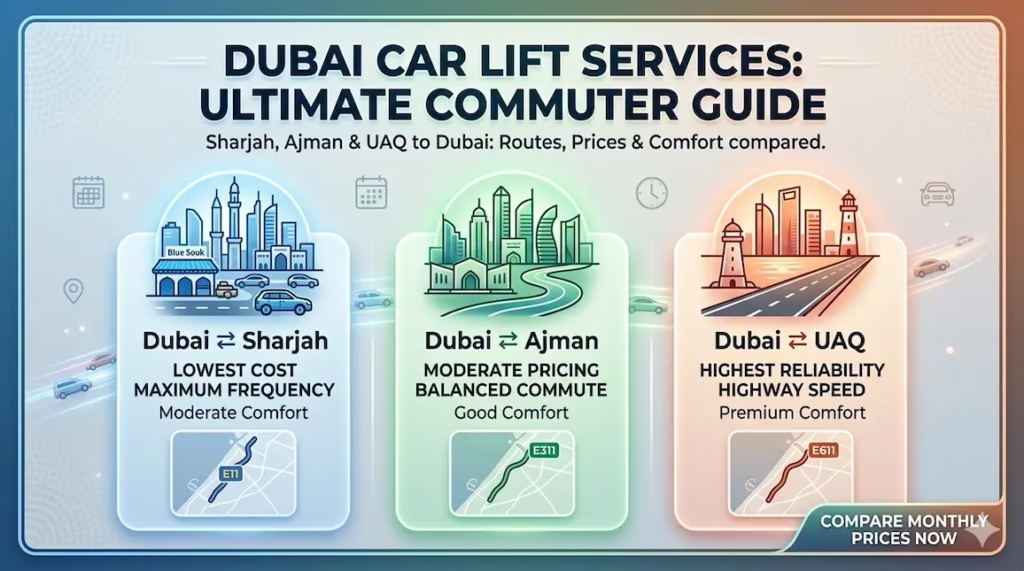
Quick Route Comparison
Choose the perfect inter-emirate route based on your budget, time, and comfort needs.
Dubai to Sharjah
Lowest overall cost and the highest service frequency, but susceptible to intense peak-hour traffic.
Dubai to Ajman
Moderate pricing with growing reliability. Offers a balanced and slightly smoother daily commute.
Dubai to UAQ
Highest distance and monthly cost, but features highly reliable highway travel with fewer bottlenecks.
Making Your Informed Decision
To pick the best option for your routine, match your decision with your daily priorities:
For Budget-Minded Commuters: The Sharjah route offers the lowest rates and the most pickup locations, making it highly accessible.
For a Balanced Routine: Ajman offers a good middle ground with reliable routes and a slightly more relaxed travel experience than Sharjah.
For Long-Distance Travelers: UAQ requires a higher financial commitment, but it provides excellent comfort and reliable highway driving.
Before making any payments, always do your homework: verify the operator’s commercial license, insist on a trial ride to evaluate driver punctuality, and make sure your vehicle is fully insured. Making an informed choice helps you protect your daily budget, arrive at work safely, and reclaim valuable personal time.